2.2.1.5 Progression of Collapse
Construction of WTC 1 resulted in the storage of more than 4x10¹¹ joules of potential energy over the 1,368-foot height of the structure. Of this, approximately 8x10⁹ joules of potential energy were stored in the upper part of the structure, above the impact floors, relative to the lowest point of impact. Once collapse initiated, much of this potential energy was rapidly converted into kinetic energy. As the large mass of the collapsing floors above accelerated and impacted on the floors below, it caused an immediate progressive series of floor failures, punching each in turn onto the floor below, accelerating as the sequence progressed. As the floors collapsed, this left tall freestanding portions of the exterior wall and possibly central core columns. As the unsupported height of these freestanding exterior wall elements increased, they buckled at the bolted column splice connections, and also collapsed. Perimeter walls of the building seem to have peeled off and fallen directly away from the building face, while portions of the core fell in a somewhat random manner. The perimeter walls broke apart at the bolted connections, allowing individual prefabricated units that formed the wall or, in some cases, large assemblies of these units to fall to the street and onto neighboring buildings below.
Review of videotape recordings of the collapse taken from various angles indicates that the transmission tower on top of the structure began to move downward and laterally slightly before movement was evident at the exterior wall. This suggests that collapse began with one or more failures in the central core area of the building. This is consistent with the observations of debris patterns from the 91st floor, previously discussed. This is also supported by preliminary evaluation of the load carrying capacity of these columns, discussed in more detail in Section 2.2.2.2. The core columns were not designed to resist wind loads and, therefore, had less reserve capacity than perimeter columns. As some exterior and core columns were damaged by the aircraft impact, the outrigger trusses at the top of the building shifted additional loads to the remaining core columns, further eroding the available factor of safety. This would have been particularly significant in the upper portion of the damaged building. In this region, the original design load for the core columns was less than at lower floors, and the column sections were relatively light. The increased stresses caused by the aircraft impact could easily have brought several of these columns close to their ultimate capacity, so that relatively little additional effects due to fire would have been required to initiate the collapse. Once movement began, the entire portion of the building above the area of impact fell in a unit, pushing a cushion of air below it. As this cushion of air pushed through the impact area, the fires were fed by new oxygen and pushed outward, creating the illusion of a secondary explosion.

2.2.2.5 Initiation of Collapse
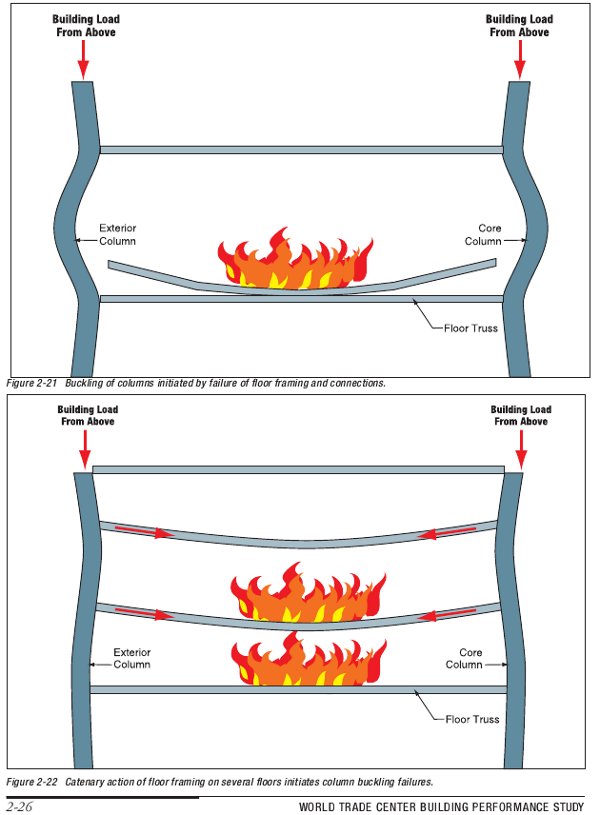
The same types of structural behaviours and failure mechanisms previously discussed are equally likely to have occurred in WTC2, resulting in the initiation of progressive collapse, approximately 56 minutes after the aircraft impact. Review of video footage of the WTC2 collapse suggests that it probably initiated with a partial collapse of the floor in the southeast corner of the building at approximately the 80th level. This appears to have been followed rapidly by collapse of the entire floor level along the east side, as evidenced by a line of dust blowing out of the side of the building. As this floor collapse occurred, columns along the east face of the building appear to buckle in the region of the collapsed floor, beginning at the south side and progressing to the north, causing the top of the building to rotate toward the east and south and to begin to collapse downward (Figure 2-32). It should be noted that failure of core columns in the southeast corner of the building could have preceded and triggered these events.
2.2.2.6 Progression of Collapse
As in WTC1, a very large quantity of potential energy was stored in the building, during its construction. Once collapse initiated, much of this energy was rapidly released and converted into kinetic energy, in the form of the rapidly accelerating mass of the structure above the aircraft inpact zone. The impact of this rapidly moving mass on the lower structure caused a wide range of structural failures in the floors directly at and below the aircraft inpact zone, in turn causing failure of these floors. As additional floor plates failed, the mass associated with each of these floors joined that of the tower above the impact area, increasing the destructive energy on the floors immediately below. This initiated a chain of progressive failures that resulted in the total collapse of the building.
A review of aerial photographs of the site, following the collapse, as well as identification of pieces of structural steel from WTC2, strongly suggests that while the top portion of the tower fell to the south and east, striking Liberty Street and the Bankers Trust building, the lower portion of the tower fell to the north and west, striking the Marriot Hotel (WTC3). Again, the debris pattern spread laterally as far as approxinately 400-500 feet from the base of the structure.