The WTC Cores As Seen In Construction Photos
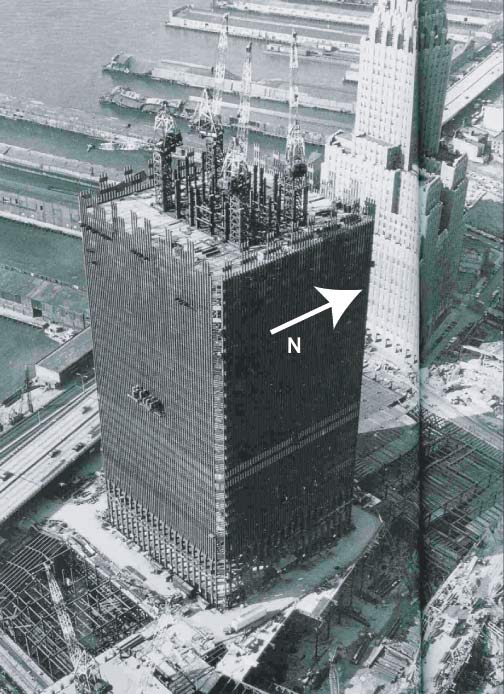
This picture is of the North Tower during construction.
The structural design of the WTC Towers is
really not that complicated. They each consist of
1) A Core structure
2) A “webbing” of perimeter columns all around the outside.
3) Large, open floors for office space. These floors are connected
to the outermost core columns on the inside, and the perimeter
columns on the outside.
Each building was built basically by repeating this pattern over and over again with very few exceptions.
The diagram below shows the layout and labelling of the core columns
according to the blueprints. North is up.
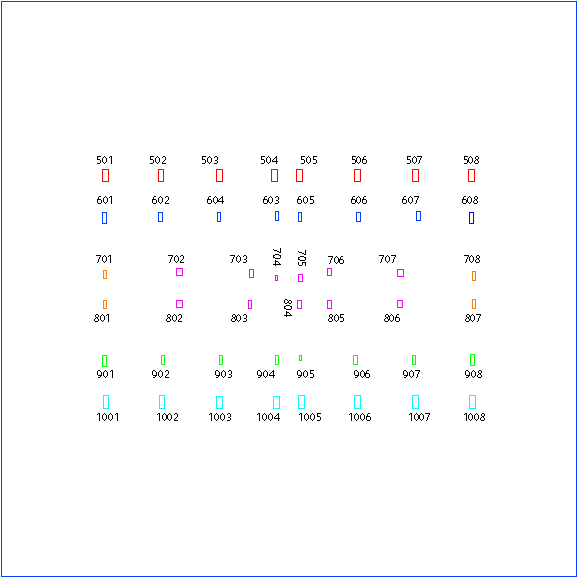
The flooring in the entire office area is directly
supported from the core by only the 24 core columns on the outside of
the core. (This point will become much clearer in pictures to follow.)
There were 4 large cranes used during construction.
They were supported by firmly attaching their bases to the large
columns in each of the 4 corners the core.

Each crane base fits inside the rectangular spaces just inside the 4 corners, shown as rectangles in the diagram above.
It is fair to say that the architects and structural designers involved
in the construction of the towers felt confident that the box columns
surrounding these these 4 corner spaces were especially strong and
secure.
After all, they were chosen as the supports to hold 4 cranes and all
their payload simultaneously during the entire construction process.
Two of these cranes are below.

The tops of the core columns sections are visible in the above image with the floor built up around them.
The builders would then place another section of core columns on top of the ones seen in this picture.
They would weld and cross-brace the next 3 story part of the core.
Then another 3 floors would be built and the whole process would repeat itself over again.
If we remember that the cranes are located inside the corners of the core, we can identify each column.
The row of columns closest to the viewer is either row 500 or row 1000.
These are the biggest and strongest columns in the building.
The pair in the foreground to our right are columns 504 and 505 (or
1004, 1005, depending which way is north).
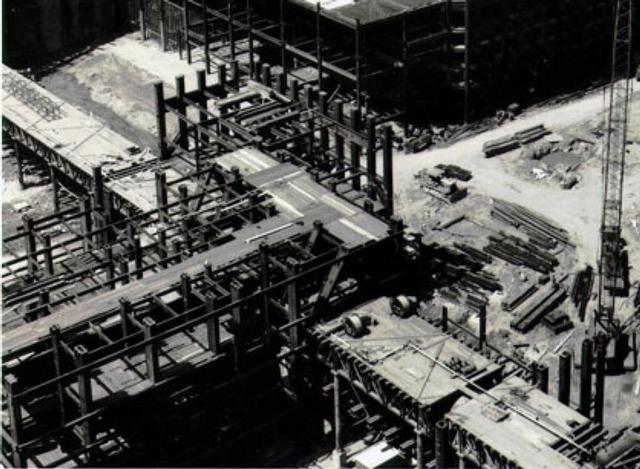
This black-and-white photo gives a truly unique glimpse inside the
core structure. This shows the very base of the core structure
being laid out for the north tower. These are the first 2 sections (the
first 72 feet) of core box columns being laid out just over the
foundation footings.
The inner core columns, consisting of columns
702 to 707 and columns 802 to 806, are positioned, spaced and even
cross-braced differently than the surrounding outer core structure.
There are 2 distinct parts of the core: The
outer and the inner core columns.
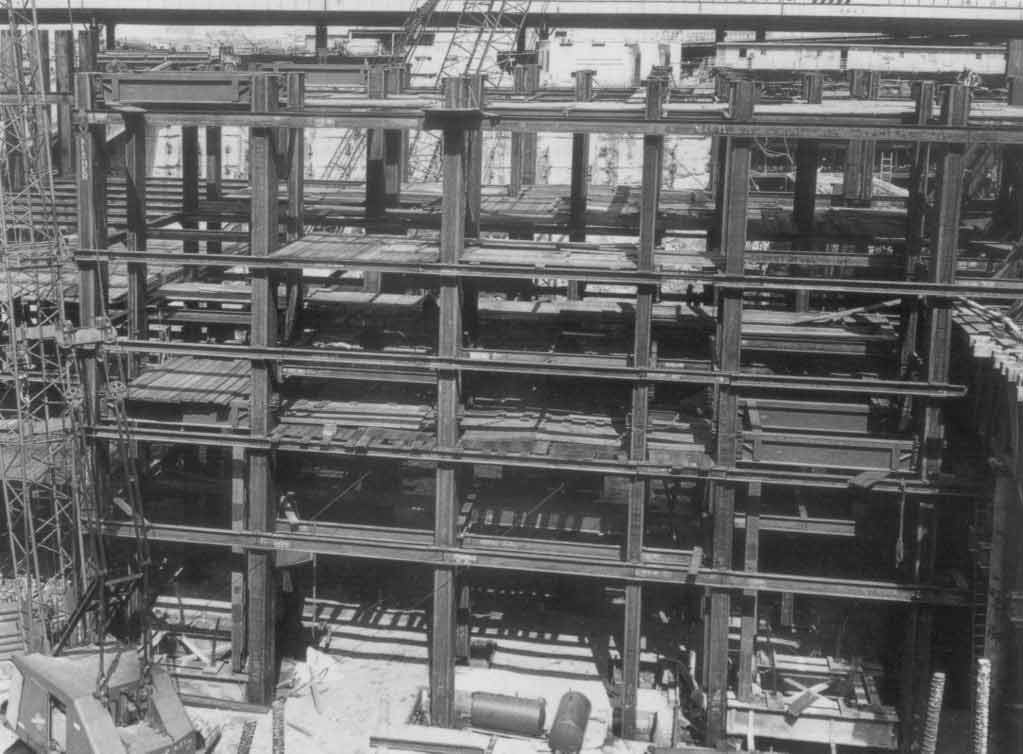
This photo was taken at about the same point of
construction as the other black-and-white picture shown before.
Some concrete footings are visible.
The tops of all columns are at the same elevation.
The bottom level will become sublevels 5 and 4. The actual flooring of
sublevel 4 is yet to be built. The
actual floor heights of sublevels 3, 2 and 1 and the service level are visible. And
as described in the essay "Floor and Weld Elevations", we know that
the sublevel 5 floor height is 11 feet
the sublevel 4 floor height is 11 feet
the sublevel 3 floor height is 10 feet
the sublevel 2 floor height is 10 feet
the sublevel 1 floor height is 10 feet
the service level is 16 feet

On Core Column Connection Planes (Weld Planes)
Combined with the other pictures of the core under construction, we have
the ability to notice the following important facts about the core
structures of the WTC towers.
Facts about the core:
1) Only the 24 outermost core columns directly support the inside part of all the flooring in the open office space area.
2) 20 of these 24 columns outermost core columns are the strongest
columns in the entire building. These would be all columns in rows 500
and 1000, and columns 601, 608, 901 and 908.
3) The core seems to be made up of 2 very different parts, the outer
core (the rectangular cross-braced outer region with cranes at each of
it's corners) and the inner core (the part inside this rectangular
region).
Each core column consists of many box column sections, stacked end to
end one on top of the other. Each box column section is about 36 feet
long (will be verified later) and spans about 3
floors.
The elevations where each column section ends and a new one begins is the same for all core columns. Hence, fact #4:
4) There were discrete, well defined horizontal planes, roughly located
every 36 feet, or 3 floors, all the way up the building, along which all
the core column sections are welded together.
These evenly spaced horizontal connection planes can also be called "weld planes".
How do we know these weld planes exist?
These weld planes are visible in every one of the photos
presented in this essay. The tops of each of the 47 core columns
certainly seem to be at the same height in every picture in this essay
and throughout the entire photo album entitled "Construction Photos".
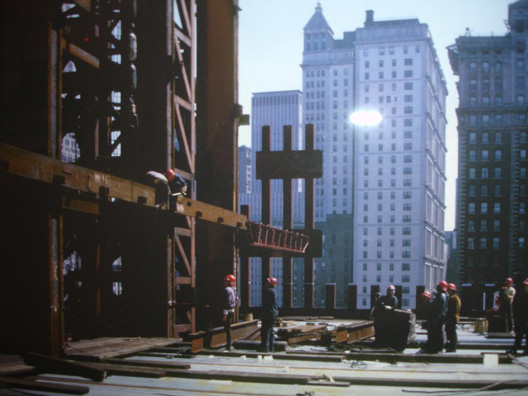
In the picture above a long lateral truss connected along
the outside edges of the 500 columns is visible. This lateral brace has small
rectangular protrusions of steel spaced every 4 feet or so along its
side. The floor joists that support the flooring in the entire open
office space will be bolted to these metal protrusions, so this lateral
braces support all the floor joists to be suspended to make the next
higher floor.
This gives further evidence that the inside connections of all floor
joists in the open office space were supported directly only by the
strongest, outermost core columns.
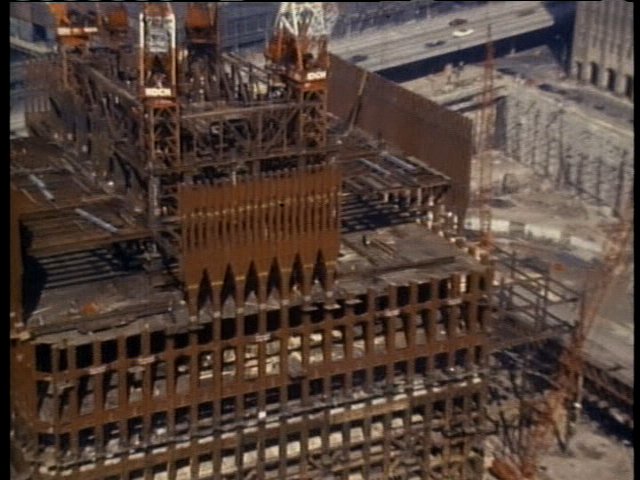
The outer core compared to the inner core. The reader can see a
rectangular group of core columns around the outside of the core with
cranes at each of the 4 corners of this rectangle. This rectangle
consists of all columns in rows 500, 600, 900 and 1000 and includes
column pairs 701, 801 and 708, 807.
Inside this rectangle are only columns from the rows 700 and 800.
Weld planes. Once again the tops
of all the core columns seem are at the same elevation. The tops of
the columns seen actually defines the fourth weld plane from the base of
the building, 2 weld planes higher than that seen in the 2
black-and-white photos seen earlier..
Open Office Flooring Joist Supports. The joists under the open
flooring between the core and the perimeter are supported from the
inside only by the outermost core columns. This is the case in the last 2 photos.